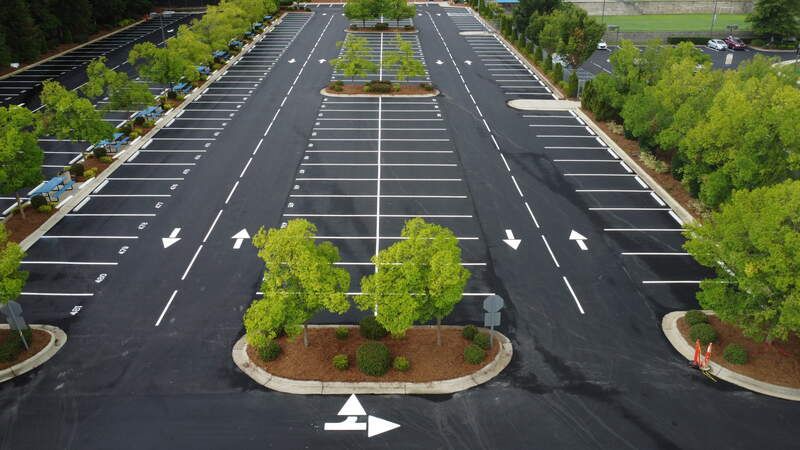
If your driveway turns into a river every time a spring storm rolls through Westchester or Fairfield County, you don't have a weather problem — you have a drainage problem. Smart driveway drainage solutions protect your asphalt, your foundation, and your wallet by sending stormwater where it belongs instead of letting it pool, freeze, and tear your pavement apart from the inside out.
This guide breaks down why drainage fails on Northeast driveways, the proven systems that fix it, and how to know which approach is right for your property — whether you're in Scarsdale, Greenwich, White Plains, Stamford, or anywhere along the I-95 and I-684 corridors.
Why Driveway Drainage Matters in Westchester & Fairfield
The Northeast is a drainage stress test. We get heavy spring rain, occasional summer downpours, autumn leaf clogs, and a winter freeze-thaw cycle that can swing 40 degrees in 24 hours. Every gallon of water that sits on or under your driveway is a future crack, pothole, or sinkhole waiting to happen.
Poor driveway drainage causes four expensive problems:
- Sub-base erosion. Water washes out the gravel base under your asphalt, creating soft spots that collapse into potholes.
- Freeze-thaw cracking. Trapped water freezes, expands roughly 9 percent, and pries cracks open wider every winter.
- Foundation damage. Driveways pitched toward the house route hundreds of gallons straight to your foundation wall and basement.
- Ice hazards. Standing water becomes glare ice overnight — a serious liability for family, mail carriers, and contractors on your property.
For homeowners in Westchester County and Fairfield County, the right driveway drainage system isn't a luxury — it's the difference between a 25-year driveway and one that needs replacement in 10.
5 Proven Driveway Drainage Solutions
1. Trench Drains (Channel Drains)
A trench drain is a long, narrow channel set flush across your asphalt driveway with a metal grate on top. It catches sheet flow before it reaches your garage door or the road and pipes it to a daylight outlet, dry well, or storm system. Trench drains are the gold standard for any driveway that slopes toward a garage, basement entrance, or street.
Best for: driveways that pitch toward the house, properties with attached garages below grade, and any pavement where surface runoff is the primary issue.
2. French Drains
A French drain is a perforated pipe surrounded by gravel and wrapped in filter fabric, buried alongside or under your driveway. Instead of catching surface water, it intercepts groundwater and subsurface flow before it can saturate your sub-base. In hilly Fairfield County towns like Greenwich, New Canaan, and Wilton, French drains are often the only way to stop water that's moving through the soil itself.
Best for: driveways at the bottom of a slope, properties with high water tables, and lots where springs or seepage keep the sub-grade wet.

Proper crown and slope are the cheapest, most effective drainage tools — and they have to be built in at the paving stage.
3. Catch Basins & Yard Inlets
A catch basin is a small underground box with a grate over it that collects water from a low spot and pipes it away. They're ideal for places where your driveway meets the lawn, where two slopes converge, or where a downspout dumps onto pavement. Pair a catch basin with a clean-out at the surface and you have a system you can flush every couple of years to keep it flowing.
4. Belgian Block Borders & Curbing
A row of Belgian block set along the edge of your driveway does triple duty: it defines the edge cleanly, prevents asphalt raveling, and acts as a curb that channels stormwater toward where you actually want it to go. For driveways that slope across a lawn, a Belgian block border can replace the need for a more invasive trench drain.
5. Permeable Pavement & Pavers
On larger residential lots and many commercial properties, permeable pavers let stormwater drain straight through the joints into a designed reservoir base below. This eliminates surface runoff entirely and, in many CT and NY municipalities, can reduce stormwater fees and help you meet local impervious-coverage limits.
The 2 Percent Rule
Every well-built driveway should have a minimum cross-slope of about 2 percent — roughly a quarter inch of fall per foot of width — pitched away from the house. If yours doesn't, no drain in the world will fully fix the problem until the surface itself is regraded. That's why we always evaluate slope before recommending a drainage system.
How to Diagnose Your Driveway's Drainage Problem
Before you spend a dollar on drains, walk your driveway during the next heavy rain. Note exactly where water pools, where it sheets across the surface, and where it disappears off the edge. The pattern tells you the fix:
- Pooling near the garage: wrong slope or missing trench drain at the apron.
- Standing water mid-driveway: a settled low spot — usually a sub-base failure that needs asphalt repair or partial repaving.
- Water running across the surface from the lawn: grading or curb issue — Belgian block or a swale will redirect it.
- Soft, spongy spots after rain: sub-base saturation — a French drain along the uphill side is your friend.
- Ice patches every winter in the same place: water is finding a low spot. Fix the slope first, then add a surface drain.
When Drainage Repair Means a New Driveway
Sometimes the cheapest fix is a fresh start. If your driveway is over 20 years old, has alligator cracking across more than 25 percent of its area, or is pitched the wrong direction from day one, retrofitting drainage is throwing good money after bad. In those cases, a full repaving with proper base prep, slope, and integrated drainage will outlast three rounds of patch-and-pray repairs.
For homeowners in Fairfield County, CT, a new driveway with the right drainage built in often costs less over its lifespan than years of band-aid drainage work on a failing surface. We're happy to give you an honest answer about which path makes sense for your property.
Commercial & HOA Drainage Considerations
Property managers running commercial parking lots or HOA private roads have an additional layer to think about: stormwater compliance. Many Westchester and Fairfield municipalities require detention, infiltration, or treatment systems for any new impervious surface above a certain threshold. Trench drains, oil-water separators, and bioswales are common requirements — and they have to be designed before the lot is paved, not after.
We routinely coordinate with civil engineers and town storm-water reviewers in towns like Stamford, Greenwich, Norwalk, Yonkers, and White Plains so that the paving and drainage are designed and built together as one system. Adjacent sidewalks and aprons need the same drainage thinking so the entire site sheds water predictably.
Frequently Asked Questions
How much do driveway drainage solutions cost in Westchester or Fairfield County?
A single trench drain installed in an existing asphalt driveway typically runs $1,800 to $4,500 depending on length, depth, and where the discharge runs. A French drain along the uphill side of a driveway is usually $25 to $50 per linear foot. A full driveway regrade with integrated drainage starts around $8 to $14 per square foot. Every property is different — slope, soil, and access all move the price.
Can I add a trench drain to an existing asphalt driveway?
Yes. We saw-cut a clean channel across the asphalt, set a pre-cast trench drain in concrete to the right elevation, run the discharge pipe to a legal outlet, and patch the asphalt around it with a hot-mix overlay. The result is a permanent fix — not a workaround.
Does sealcoating help with driveway drainage?
Sealcoating waterproofs the surface and stops water from soaking into the asphalt itself, which is a real benefit. But it does not change the slope and it does not move water off the surface. If you have pooling, a drain — not a sealcoat — is the answer. Sealcoating is the right next step once the drainage is fixed.
Will the town make me submit drainage plans?
For a residential driveway, usually no — most repairs and small drains are owner-permitted at most. For commercial work, new construction, or any project that increases impervious coverage, several Westchester and Fairfield towns require a stormwater review. We handle the paperwork on the projects we build.
Tired of fighting your driveway every time it rains? Get a free on-site driveway drainage assessment from JL Construction Group — call (203) 658-6744 today.